Orcas: Wolves of the Sea
The 2010 death of trainer Dawn Brancheau at SeaWorld Orlando came as a shock to the world. Brancheau was an experienced trainer who had worked with orcas for 15 years. The day of her death, she was performing a show with Tilikum, a large male killer whale, who drowned her. According to SeaWorld executives, orcas and other performing animals, such as dolphins and sea lions, live good lives in captivity with medical care and loving trainers. They claimed that the death of Dawn Brancheau was a random accident due to trainer error.
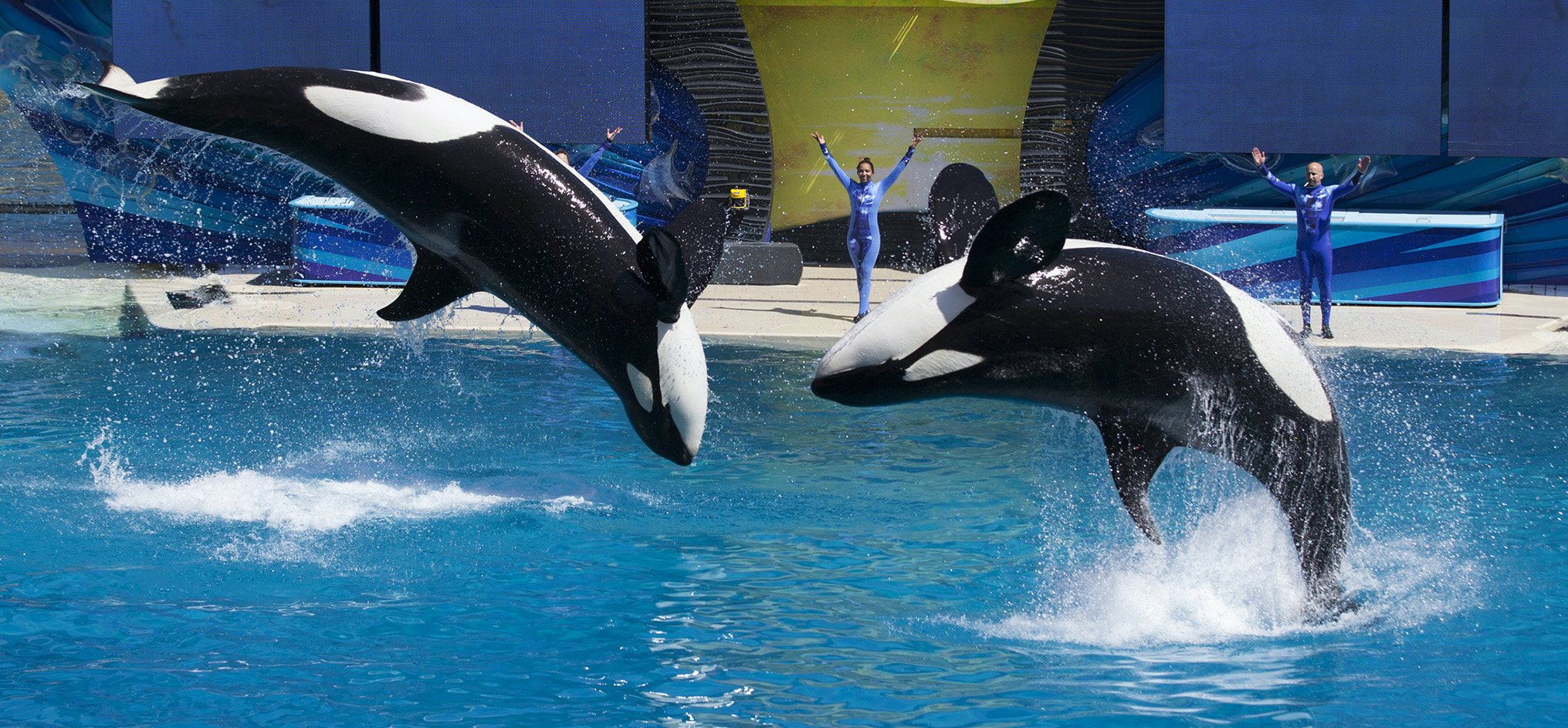
The trauma and isolation of life in captivity take a severe psychological toll on animals that normally swim hundreds of miles each day and live in structured family groups. Over the course of years in captivity in concrete pools lacking mental stimulation and family units, orcas become aggressive and irritable. Since 1961, wild orcas were caught to be sold to aquariums and entertainment venues. Most often, young animals are caught because they are smaller and easier to handle and train for life in captivity. Tilikum was captured off the southwest coast of Iceland in 1983 when he was ~2 years old. Live orca capture by SeaWorld continued until orcas were successfully bred in captivity in 1985.
The 2013 documentary Blackfish focuses on Tilikum’s life in captivity, which included killings of 3 humans in total, in addition to orca biology and numerous other incidents involving trainers and captive orcas. The film elicited public outrage over the treatment of orcas in captivity, leading to pressure on SeaWorld to stop captive orca breeding in 2016 1 and switch its focus to conservation and education, rather than entertainment. The last captive-bred orca was born in SeaWorld in 2017, but she died at 3 months old of pneumonia 2.
General Information
Orcas are the largest member of the dolphin family. Orcas are toothed whales, so they eat animals like fish, seals, sharks, and even other whales, and they are apex predators, so no other animal preys on them. Toothed whales, as the name suggests, have teeth to catch prey, while baleen whales use baleen to filter out krill and small fish from the water. Other toothed whales are dolphins, beluga whales, narwhals, sperm whales, and pilot whales. Since they live in groups called pods, orcas work together to take down large prey, such as great white sharks and much larger baleen whales. These characteristics give them the nickname “wolves of the sea.”
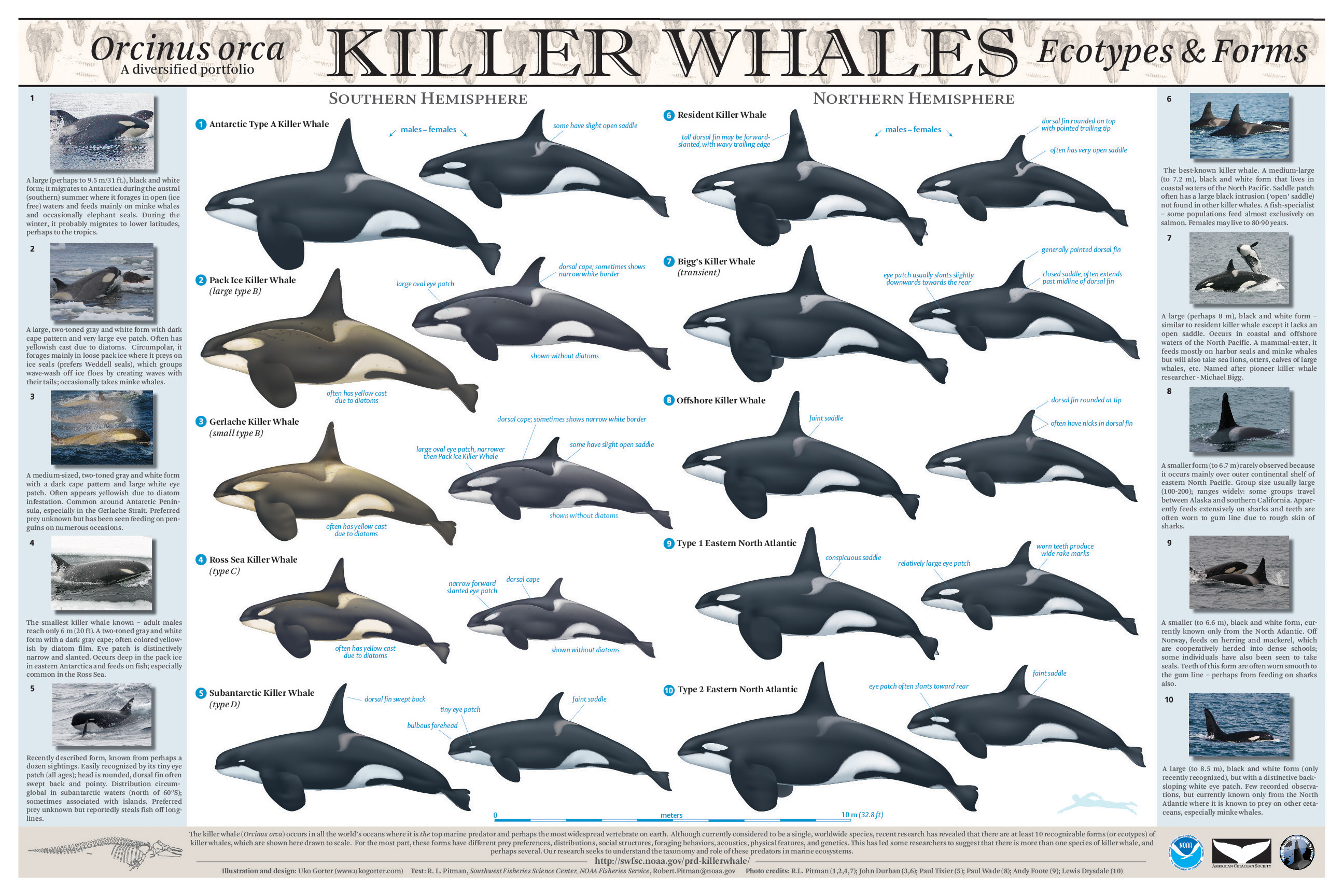
Orcas are found in all oceans of the world, but they are not a single population. Orcas are divided into ecotypes, genetically distinct populations that are adapted to different environmental conditions. All of these are still part of the same species, however. Some orcas have a distinct yellowish tinge in their white spots due to algae in the water. The figure below shows the killer whale ecotypes in the Northern and Southern hemispheres. In addition to different coloration patterns, the different ecotypes have different diets and live in different environments.
Male orcas are bigger than females, and their dorsal fins are larger and straighter, averaging 6 feet in length. Captive male orcas have collapsed dorsal fins, a sign of poor health and lack of activity. The dorsal fin is composed of flexible connective tissue, not bone, and without high speed swimming and significant activity, it can collapse due to gravity or low blood pressure in whales that are sedentary in captivity. Another likely explanation is collagen softening due to overheating because the whales spend most of their time at the surface exposed to the warmer air and ultraviolet (UV) radiation. Long-term exposure to UV radiation can also lead to cancer in orcas, like in humans.
In a 1998 study of dorsal fin damage to wild orcas in New Zealand, very few dorsal fin collapses were observed, and orcas with collapsed fins had sustained trauma from boat accidents 3. On the other hand, all male orcas in captivity have collapsed dorsal fins, and many females do so as well.
Orcas use echolocation to sense their surroundings and hunt prey. Echolocation is like sonar; the animals make high frequency clicks, whistles, and other sounds, and the sound reflects off of other objects in the water and returns to the orcas. Based on the time between when orcas generate a sound and when they receive it, as well as the delay between the arrival of the sound at each ear, orcas can determine the location of objects in the water. They can also quickly identify the size, shape, composition, and movement of an object. This ability is shared by toothed whales, many species of bats, and some birds.
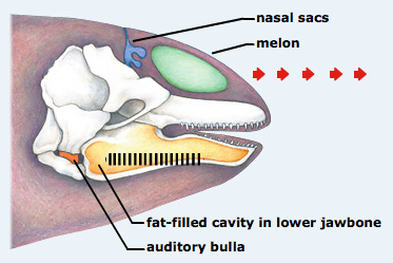 To generate sounds for echolocation, toothed whales take in air through the blowhole to inflate the nasal air sacs. The air is then released to produce sound in a similar fashion to releasing air from a balloon. Located just above the snout is a mass of fatty tissue called the melon that focuses outgoing sounds into a beam. The returning sound waves enter through the lower jaw, the bones of which have fat-filled cavities that conduct sound to the middle and inner ears.
 Orcas have ear openings located under the white eye patch, but since sound normally enters through the lower jaw, the function of the ear is not well-understood. Some scientists believe that toothed whales have ear channels that are open and filled with seawater. This would be necessary for whales to hear in water because the transmission of sound between air and water is very poor. That’s why if you shout underwater, the sound doesn’t travel well. Water conducts sound better than air, but the sound has to travel from your air-filled larynx to the water. Other scientists think that the ear channel is closed off, possibly by a wax plug, and both the channel and ear hole are vestigial organs left over from terrestrial ancestors.
Social Structures and Raising Young
Orcas live in matriarchal pods, which means they are led by females. There is typically an older female whale who leads the pod in navigation and hunting, and the rest of the whales are related to her. Both male and female orcas live with the pods that they were born into for many years, which may contain anywhere from 5 to 50 individuals. Orcas are very social and not territorial, and different pods frequently share the same territory 6. Multiple pods of extended related individuals my travel and hunt together.
Orcas and short-finned pilot whales are the only animals aside from humans that go through menopause. The average life expectancy of male orcas is around 30 years, but females live on average 50-80 years. Females stop reproducing around age 40, and during the next few decades of life, they continue to help raise the calves of younger females.
Scientists speculate that menopause may have evolved in killer whales because members of a pod share and sometimes fight over the food they catch. Older female whales have a better chance of making sure their genes are passed on to future generations by helping the children of their podmates (who are all related to the matriarch leading the pod) survive than by reproducing further and causing more competition for food.4,5 The rest of the pod also benefits from the matriarch's experiences hunting and surviving.
Intelligence
Culture is a set of beliefs, behaviors, and language that is passed down through generations of a species. From studies on orcas, we know that they teach their young many behaviors, communicate in language patterns that are distinct between groups, and have strong social bonds between individuals throughout their lifetimes. All of these suggest that orcas have a culture.
Orcas have learned many different hunting techniques depending on their prey. Orcas that primarily eat fish have developed methods like carouseling to corral fish into a tight spinning ball. Orcas continually swim around the ball, startling fish by flashing their bright white undersides, blowing bubbles, and slapping the surface of the water. Other orcas slap their tails at the fish to stun them, making them easy pickings. In Antarctica, orcas work together to make large waves to topple seals from ice floes. Many orcas intentionally beach themselves to surprise and catch seals on land. They time their beachings with the tides so that they won’t get stuck on land for very long. All of these behaviors are learned, and calves watch and imitate their mothers and other females. The behaviors are passed on, forming a heritable culture.
Some dolphin populations use tools while searching for food. In Shark Bay, Australia, bottlenose dolphins hold sponges at the front of their rostrums (snouts) to help them search for fish on the seabed 7. This behavior is taught by mothers to their calves, but preferentially to their daughters, though the reason is unclear 8.
Orcas and dolphins have a sense of self-awareness, which means that they can distinguish themselves from other members of their species abstractly. You can think of self-awareness as the ability to look in a mirror and know that the reflection is you, not just any human. Animal behaviorists test this ability using the mirror test. An animal is anesthetized and then marked with paint or a sticker on an area of the body the animal cannot normally see. When the animal recovers from the anesthetic, it is shown a mirror If the animal then touches or investigates the mark, we infer that the animal perceives the reflected image as itself, rather than another animal. Very few species have passed the mirror test, including great apes, a single Asiatic elephant, dolphins, orcas, and a few birds. This sense of self develops as an animal grows and interacts with other members of its group, and as such, is most often seen in social animals. Humans do not typically pass the test until 18 months of age.
Orcas experience grief and other emotions. Since many calves die, mother orcas have often been observed pulling their dead calves around while swimming, but none as long as a female orca known as J35 in the Southern Resident population 9. Her calf died within 30 minutes of birth, and she pushed it for 17 days. Other orcas noticed that she was not eating enough and brought her food, even taking turns pulling the baby orca to give the mother a rest. In captivity, mothers and calves are frequently separated based on the needs of parks, frequently causing audible emotional distress 10. Many types of dolphins and orcas have been known to help sick or injured members of their pods by pushing them to the surface and bringing them food, showing empathy and caring. Whales and dolphins have very large and complex brains, contributing to their intelligence and complex social structures 11.
Gyrification is the degree to which the brain tissue is folded. The name derives from gyrus, the name for a peak of a tissue fold. Brains with more gyrification can process more information faster because the surface area of the brain is larger, and electrical impulses are conducted faster between neurons because they have to travel shorter distances between folds. The gyrification index is a ratio of the amount of cortex inside the folds as compared to the amount of cortex on the outer visible cortex. Below is a diagram that shows how it’s calculated:
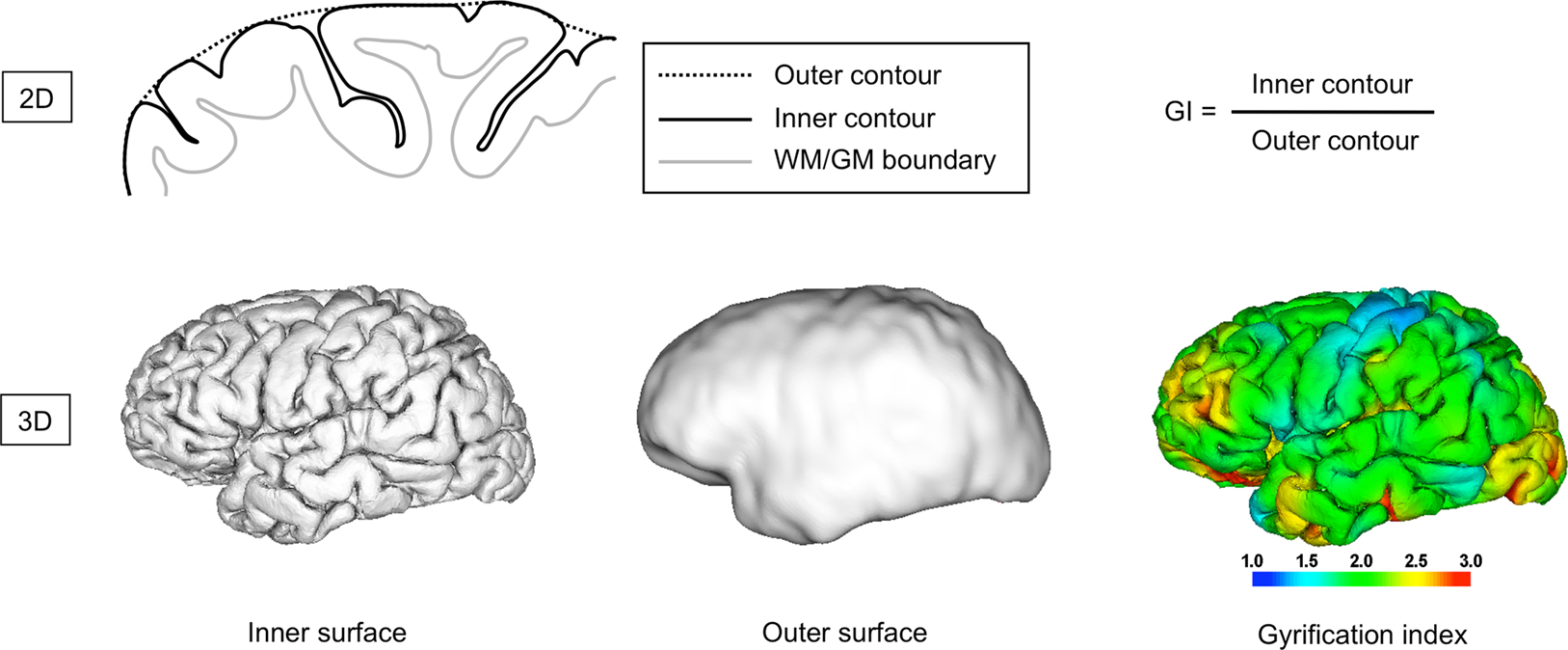
The human brain has an average gyrification index around 2.5, and for dolphins and orcas, it is typically more than 4.5 12. This means that dolphin brains have significantly more folding than brains of humans. It is unclear how exactly this affects the relative intelligence and behaviors of humans and dolphins, but some scientists speculate that more folds and bigger brain regions devoted to processing auditory stimuli may help toothed whales interpret echolocation information quickly.
Evolution
Based on genetic studies and analyses of skull and inner ear structures, whales are most closely related to hoofed mammals like deer, cows, sheep, pigs, giraffes, camels, and hippos. Whales share a most recent common ancestor with hippos. This common ancestor was small, had 4 legs, and walked on land around 50-55 million years ago. After 10-15 million years, whales in their present form appeared in the fossil record.
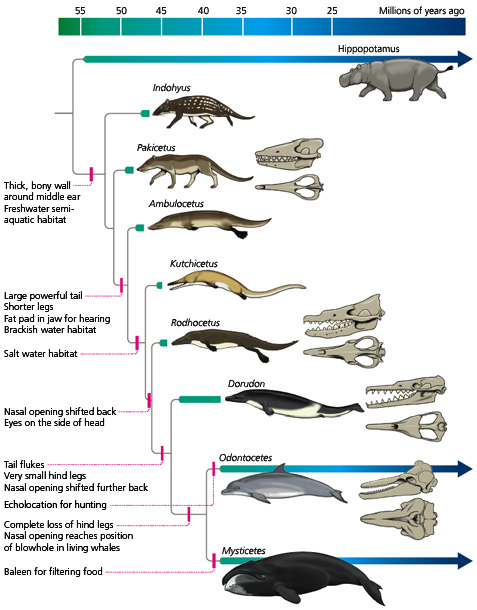
Evogram of whales and their closest known relatives. An evogram is a type of phylogenetic tree that shows the evolutionary relatedness of species with a time scale. This evogram also shows when certain whale characteristics developed. In the evogram, none of the organisms are direct ancestors of each other. They are related organisms that are better thought of as cousins. Source: University of Berkeley.
Whales evolved from a small land animal that adapted to aquatic life, perhaps as a way to avoid predators or look for food 13. Millions of years of evolution separate Pakicetus 14, the most primitive whale ancestor, and modern whales. Over time, the bodies of whale ancestors became larger, more streamlined, and gained webbed limbs that eventually became flippers.
Ambulocetus is the first whale ancestor that looks adapted for aquatic life. It had a much more streamlined body, likely had webbed limbs, and was around the size of a sea lion. Based on isotope analysis in fossilized bones and teeth, scientists inferred that Ambulocetus lived in both salt and freshwater 15. Prehistoric whales had small brains relative to their body sizes. Large brains evolved later in the whale family tree, with toothed whales ultimately having the largest brains relative to body mass.
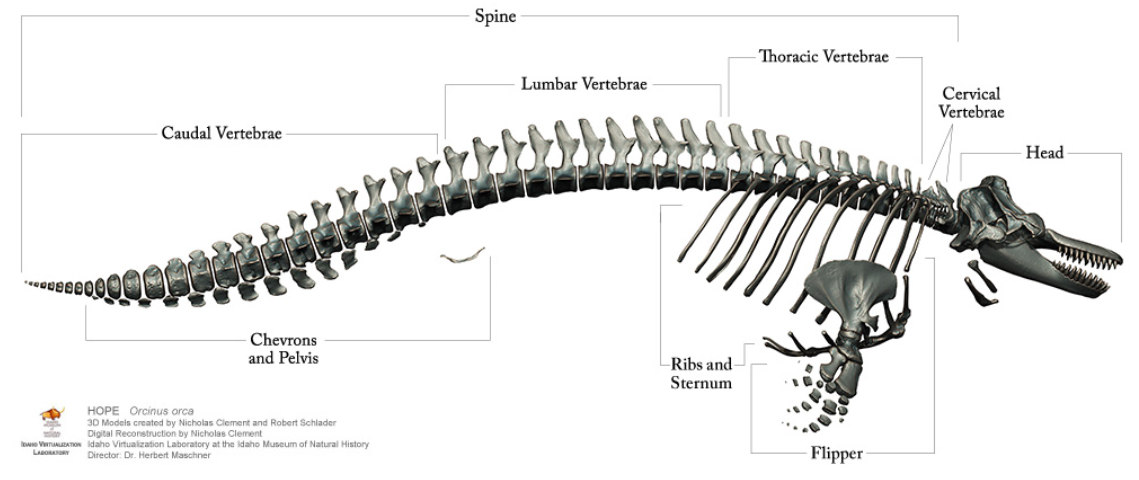
Whales share many anatomical features with land-dwelling animals, suggesting that they evolved from a common ancestor. If you look at the skeleton of all whales, you see that inside each flipper, there are 5 sets of bones just like in our hands and feet. Most whales have vestigial pelvic bones under their spines that serve no purpose. These bones are relics of land-dwelling ancestors, whose legs attached to the spine via the pelvis (hip). Vestigial features are costly to maintain because they do not have any function, so over millions of years, they shrink or are even lost. Orca tails contain another set of bones called chevrons below the spine. Chevrons help stabilize the large muscles that move the tail. Beavers, kangaroos, and many dinosaur species also have/had chevrons to stabilize their tails.
Conclusion
Orcas are highly social, emotionally intelligent animals that suffer greatly in confinement. In captivity, orcas may not readily form pods with the animals they’re housed with, leading to stress and sometimes fatal fights between individuals. In the wild, this type of aggressive behavior is rarely seen, and when orcas are upset, they have the entire ocean in which to separate from each other. Many captive orcas died prematurely from lung problems or mosquito-borne illnesses. Because captive orcas spend so much time at the surface and are stationary for long periods of time, they are at greater risk of mosquito bites than wild orcas 16.
Captive orcas have slim chances of being reintroduced into the wild because they lack hunting skills and are unlikely to find pods that will accept them. Keiko was a 2-3 year old male orca who had been captured in Iceland in 1979. He starred in Free Willy, which led to a public campaign to release him into the wild. His rehabilitation began in 1996, and he was free in the summer of 2002. Keiko was able to feed and follow orca pods at distances, but he sought out human contact and was even fed by caretakers, and he died in December 2003 of pneumonia. His rehabilitation was considered a failure because Keiko never fully adjusted to life in the wild.
Many people believed that the ~$20 million spent on Keiko's rehabilitation and release could have been used to improve the conditions of captive orcas and establish sea pens. Sea pens are semi-enclosed structures in which animals can roam and find fish independently, but are still monitored by human staff. Although orcas won’t be able to do all of their natural behaviors in these enclosures, it will be better for the animals’ emotional and physical health to become less dependent on humans in a more controlled environment than the open ocean.
Leave a Comment